Every whiteboard looks similar from a distance, but the surface underneath decides whether markers glide or drag, whether a projected image stays sharp, and whether the board reads as a design feature or just office equipment. Chameleon builds every board on the same ceramic steel base, then finishes it as glossy, matte, chalk or glass, each suited to a different room and a different way of working. This guide walks through what each surface actually does differently, so the choice is based on how the board will be used, not on which name happens to sound familiar.

Array
(
    [1049] => WP_Post Object
        (
            [ID] => 1049
            [post_author] => 1
            [post_date] => 2026-10-20 06:45:09
            [post_date_gmt] => 2019-08-05 13:54:24
            [post_content] =>
            [post_title] => Products
            [post_excerpt] =>
            [post_status] => publish
            [comment_status] => closed
            [ping_status] => closed
            [post_password] =>
            [post_name] => whiteboards-5
            [to_ping] =>
            [pinged] =>
            [post_modified] => 2026-10-20 06:45:09
            [post_modified_gmt] => 2026-10-20 06:45:09
            [post_content_filtered] =>
            [post_parent] => 0
            [guid] => https://chameleonwriting.falkor.alcor.cloud/?p=1049
            [menu_order] => 1
            [post_type] => nav_menu_item
            [post_mime_type] =>
            [comment_count] => 0
            [filter] => raw
            [db_id] => 1049
            [menu_item_parent] => 0
            [object_id] => 1049
            [object] => custom
            [type] => custom
            [type_label] => Custom Link
            [title] => Products
            [url] => #
            [target] =>
            [attr_title] =>
            [description] =>
            [classes] => Array
                (
                    [0] =>
                )

            [xfn] =>
        )

    [12842] => WP_Post Object
        (
            [ID] => 12842
            [post_author] => 82
            [post_date] => 2026-10-20 06:45:10
            [post_date_gmt] => 2023-08-31 08:07:16
            [post_content] =>
            [post_title] =>
            [post_excerpt] =>
            [post_status] => publish
            [comment_status] => closed
            [ping_status] => closed
            [post_password] =>
            [post_name] => 12842
            [to_ping] =>
            [pinged] =>
            [post_modified] => 2026-10-20 06:45:10
            [post_modified_gmt] => 2026-10-20 06:45:10
            [post_content_filtered] =>
            [post_parent] => 0
            [guid] => https://chameleonwriting.falkor.alcor.cloud/?p=12842
            [menu_order] => 68
            [post_type] => nav_menu_item
            [post_mime_type] =>
            [comment_count] => 0
            [filter] => raw
            [db_id] => 12842
            [menu_item_parent] => 0
            [object_id] => 12839
            [object] => page
            [type] => post_type
            [type_label] => Page
            [url] => https://chameleonwriting.com/en/references-3/
            [title] => References
            [target] =>
            [attr_title] =>
            [description] =>
            [classes] => Array
                (
                    [0] =>
                )

            [xfn] =>
        )

    [11862] => WP_Post Object
        (
            [ID] => 11862
            [post_author] => 82
            [post_date] => 2026-10-20 06:45:10
            [post_date_gmt] => 2023-08-21 13:36:51
            [post_content] =>
            [post_title] => pCon
            [post_excerpt] =>
            [post_status] => publish
            [comment_status] => closed
            [ping_status] => closed
            [post_password] =>
            [post_name] => pcon-data
            [to_ping] =>
            [pinged] =>
            [post_modified] => 2026-10-20 06:45:10
            [post_modified_gmt] => 2026-10-20 06:45:10
            [post_content_filtered] =>
            [post_parent] => 642
            [guid] => https://chameleonwriting.falkor.alcor.cloud/?p=11862
            [menu_order] => 69
            [post_type] => nav_menu_item
            [post_mime_type] =>
            [comment_count] => 0
            [filter] => raw
            [db_id] => 11862
            [menu_item_parent] => 0
            [object_id] => 4701
            [object] => page
            [type] => post_type
            [type_label] => Page
            [url] => https://chameleonwriting.com/en/information/chameleon-now-available-in-pcon/
            [title] => pCon
            [target] =>
            [attr_title] =>
            [description] =>
            [classes] => Array
                (
                    [0] =>
                )

            [xfn] =>
        )

    [32752] => WP_Post Object
        (
            [ID] => 32752
            [post_author] => 85
            [post_date] => 2026-10-20 06:45:10
            [post_date_gmt] => 2025-08-07 10:59:20
            [post_content] =>
            [post_title] => Order Samples
            [post_excerpt] =>
            [post_status] => publish
            [comment_status] => closed
            [ping_status] => closed
            [post_password] =>
            [post_name] => order-samples-2
            [to_ping] =>
            [pinged] =>
            [post_modified] => 2026-10-20 06:45:10
            [post_modified_gmt] => 2026-10-20 06:45:10
            [post_content_filtered] =>
            [post_parent] => 0
            [guid] => https://chameleonwriting.com/?p=32752
            [menu_order] => 70
            [post_type] => nav_menu_item
            [post_mime_type] =>
            [comment_count] => 0
            [filter] => raw
            [db_id] => 32752
            [menu_item_parent] => 0
            [object_id] => 32718
            [object] => page
            [type] => post_type
            [type_label] => Page
            [url] => https://chameleonwriting.com/en/chameleon-samples/
            [title] => Order Samples
            [target] =>
            [attr_title] =>
            [description] =>
            [classes] => Array
                (
                    [0] =>
                )

            [xfn] =>
        )

    [26482] => WP_Post Object
        (
            [ID] => 26482
            [post_author] => 85
            [post_date] => 2026-10-20 06:45:10
            [post_date_gmt] => 2025-01-17 11:08:57
            [post_content] =>
            [post_title] => Information
            [post_excerpt] =>
            [post_status] => publish
            [comment_status] => closed
            [ping_status] => closed
            [post_password] =>
            [post_name] => information-2
            [to_ping] =>
            [pinged] =>
            [post_modified] => 2026-10-20 06:45:10
            [post_modified_gmt] => 2026-10-20 06:45:10
            [post_content_filtered] =>
            [post_parent] => 0
            [guid] => https://chameleonwriting.com/?p=26482
            [menu_order] => 71
            [post_type] => nav_menu_item
            [post_mime_type] =>
            [comment_count] => 0
            [filter] => raw
            [db_id] => 26482
            [menu_item_parent] => 0
            [object_id] => 26482
            [object] => custom
            [type] => custom
            [type_label] => Custom Link
            [title] => Information
            [url] => #
            [target] =>
            [attr_title] =>
            [description] =>
            [classes] => Array
                (
                    [0] =>
                )

            [xfn] =>
        )

    [36031] => WP_Post Object
        (
            [ID] => 36031
            [post_author] => 85
            [post_date] => 2026-10-20 06:45:10
            [post_date_gmt] => 2025-11-12 11:54:33
            [post_content] =>
            [post_title] => ProTips
            [post_excerpt] =>
            [post_status] => publish
            [comment_status] => closed
            [ping_status] => closed
            [post_password] =>
            [post_name] => protips-2
            [to_ping] =>
            [pinged] =>
            [post_modified] => 2026-10-20 06:45:10
            [post_modified_gmt] => 2026-10-20 06:45:10
            [post_content_filtered] =>
            [post_parent] => 0
            [guid] => https://chameleonwriting.com/?p=36031
            [menu_order] => 78
            [post_type] => nav_menu_item
            [post_mime_type] =>
            [comment_count] => 0
            [filter] => raw
            [db_id] => 36031
            [menu_item_parent] => 0
            [object_id] => -325
            [object] => kennisbank
            [type] => post_type_archive
            [title] => ProTips
            [type_label] => Post Type Archive
            [url] => https://chameleonwriting.com/en/protips/
            [target] =>
            [attr_title] =>
            [description] =>
            [classes] => Array
                (
                    [0] =>
                )

            [xfn] =>
        )

    [19332] => WP_Post Object
        (
            [ID] => 19332
            [post_author] => 3
            [post_date] => 2026-10-20 06:45:10
            [post_date_gmt] => 2024-05-14 11:58:44
            [post_content] =>
            [post_title] => Contact
            [post_excerpt] =>
            [post_status] => publish
            [comment_status] => closed
            [ping_status] => closed
            [post_password] =>
            [post_name] => contact-4
            [to_ping] =>
            [pinged] =>
            [post_modified] => 2026-10-20 06:45:10
            [post_modified_gmt] => 2026-10-20 06:45:10
            [post_content_filtered] =>
            [post_parent] => 0
            [guid] => https://chameleonwriting.com/?p=19332
            [menu_order] => 79
            [post_type] => nav_menu_item
            [post_mime_type] =>
            [comment_count] => 0
            [filter] => raw
            [db_id] => 19332
            [menu_item_parent] => 0
            [object_id] => 19332
            [object] => custom
            [type] => custom
            [type_label] => Custom Link
            [title] => Contact
            [url] => https://chameleonwriting.com/en/contact/
            [target] =>
            [attr_title] =>
            [description] =>
            [classes] => Array
                (
                    [0] =>
                )

            [xfn] =>
        )

    [12326] => WP_Post Object
        (
            [ID] => 12326
            [post_author] => 82
            [post_date] => 2026-10-20 06:45:10
            [post_date_gmt] => 2023-08-25 07:08:58
            [post_content] =>
            [post_title] => Languages
            [post_excerpt] =>
            [post_status] => publish
            [comment_status] => closed
            [ping_status] => closed
            [post_password] =>
            [post_name] => taalschakelaar-6
            [to_ping] =>
            [pinged] =>
            [post_modified] => 2026-10-20 06:45:10
            [post_modified_gmt] => 2026-10-20 06:45:10
            [post_content_filtered] =>
            [post_parent] => 0
            [guid] => https://chameleonwriting.falkor.alcor.cloud/?p=12326
            [menu_order] => 80
            [post_type] => nav_menu_item
            [post_mime_type] =>
            [comment_count] => 0
            [filter] => raw
            [db_id] => 12326
            [menu_item_parent] => 0
            [object_id] => 12326
            [object] => custom
            [type] => custom
            [type_label] => Language switcher
            [title] => EN
            [url] => #pll_switcher
            [target] =>
            [attr_title] =>
            [description] =>
            [classes] => Array
                (
                    [0] => pll-parent-menu-item
                )

            [xfn] =>
        )

)
1
News
Types of whiteboard surfaces: glossy, matte, chalk and glass compared
Every Chameleon surface starts with the same ceramic steel
Whatever finish you choose, every Chameleon whiteboard is built on the same ceramic steel: a thin layer of glass fused onto steel, not painted or coated on top. That construction is what makes the surface scratch resistant, fully magnetic and covered by a lifetime warranty on writing and erasing, regardless of which finish sits on it. The differences below come from how that surface is treated, not from a different underlying material. Any of them can be specified on every Chameleon whiteboard.
High Gloss
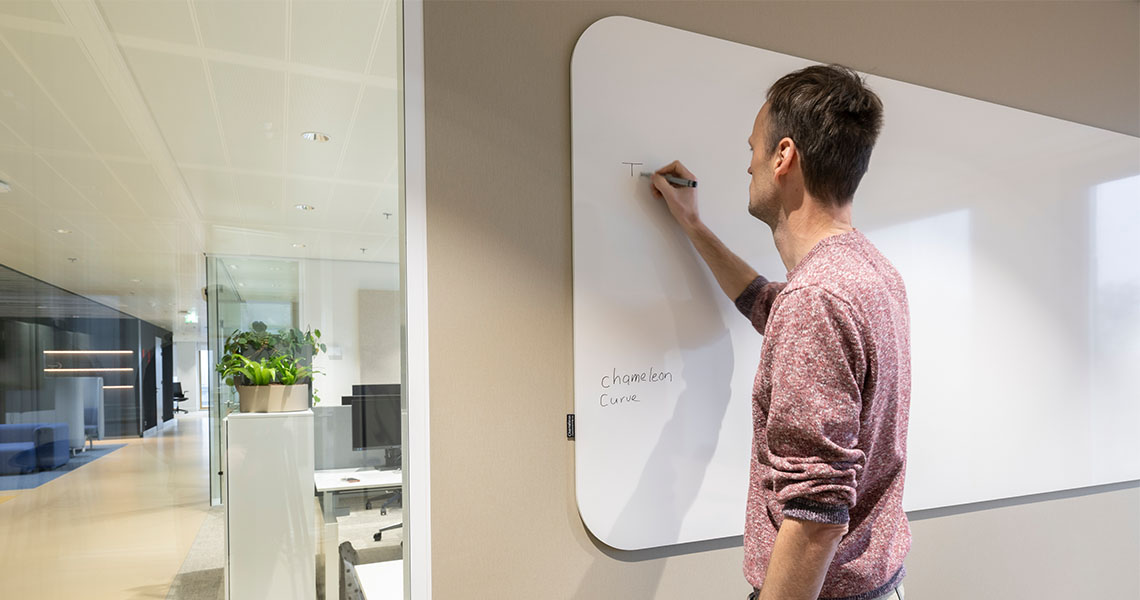
High Gloss is the classic whiteboard surface and the one most people picture when they think of a whiteboard. Its bright, reflective finish keeps markings clearly visible from a distance, which is why it remains the default choice for classrooms, lecture halls and any room where people read the board from across the space. It carries a lifetime warranty on writing and erasing, and cleans easily with a dry or slightly damp cloth. If the reflection itself becomes distracting, in a room with a lot of daylight or screens nearby, SatinTones is the better fit.
SatinTones
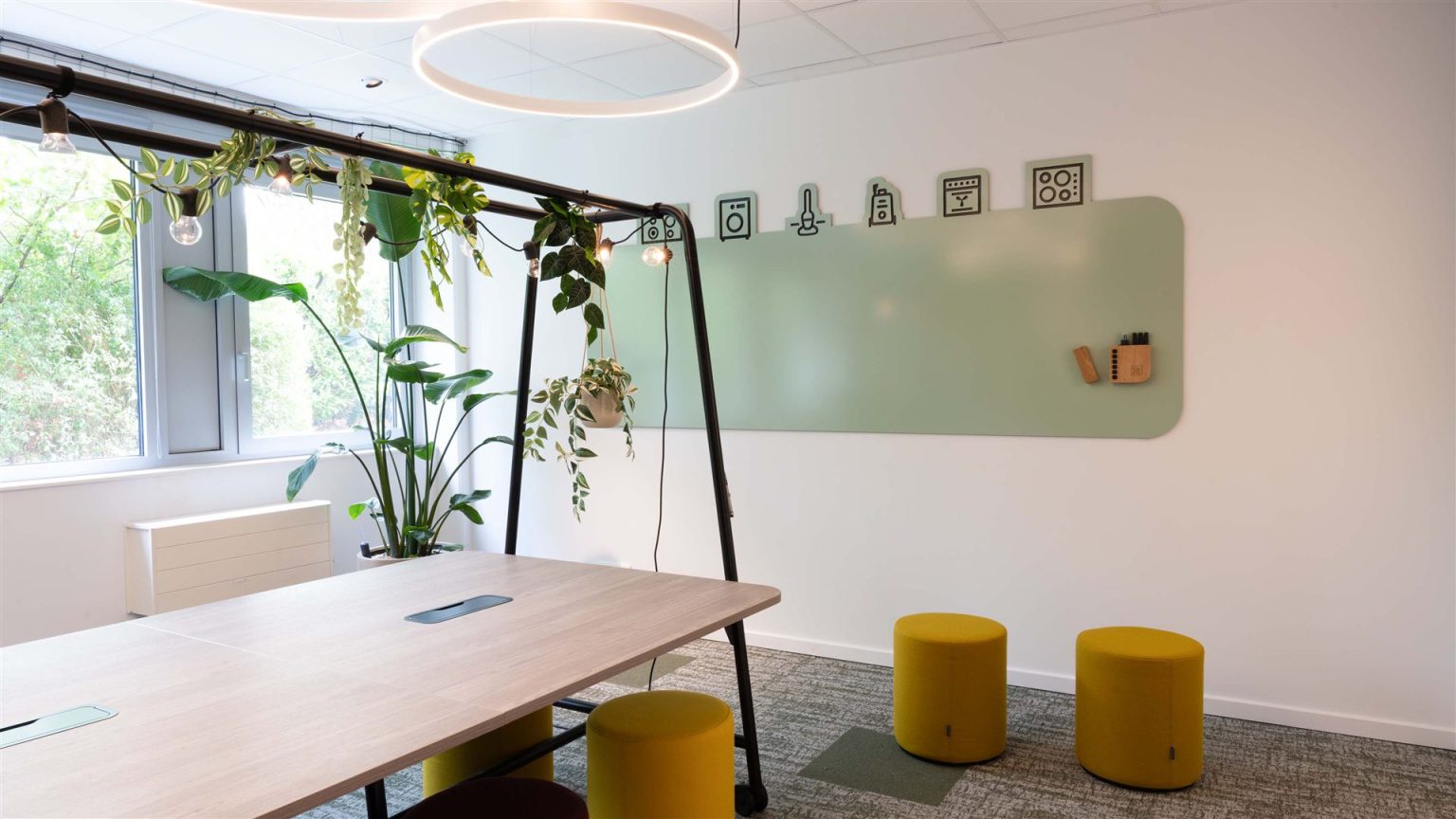
SatinTones has overtaken High Gloss as Chameleon’s best-selling surface, and it’s easy to see why: a matte writing surface available in 15 colour tones rather than only white. Because it reflects far less light than High Gloss, it stays readable from every angle, even under bright daylight or artificial lighting, which is exactly why it’s often searched for as a “matte dry erase board”. Writing and erasing performance is identical to High Gloss, but the colour is fired directly into the ceramic steel rather than painted on, so it holds up the same way over years of daily use. SatinTones also blends into an interior far more easily than a glossy white panel, since the finish can be matched to wood, textiles or wall colour instead of standing out against it.
Glossy or matte, and chalkboard or whiteboard: how the finishes actually compare
Two comparisons come up constantly when specifying a board, and both come down to the room rather than performance. High Gloss and SatinTones write and erase identically, the choice is about light: High Gloss suits rooms where the board is read from a distance, SatinTones suits bright or glass-walled rooms where reflection becomes a distraction, and interiors where the board should blend in rather than stand out as a glossy white panel. Chalkboard versus whiteboard is a similar story. Chalk lets you vary a line’s weight by pressing harder or softer, which no whiteboard marker can replicate, and it holds up to repeated writing on the same spot without ghosting. Against that, chalk produces dust and needs chalk rather than markers to keep contrast crisp. Every finish, glossy, matte or chalk, is built on the same ceramic steel and carries the same lifetime warranty on writing and erasing, so none of them is a technical upgrade over another.
Projection
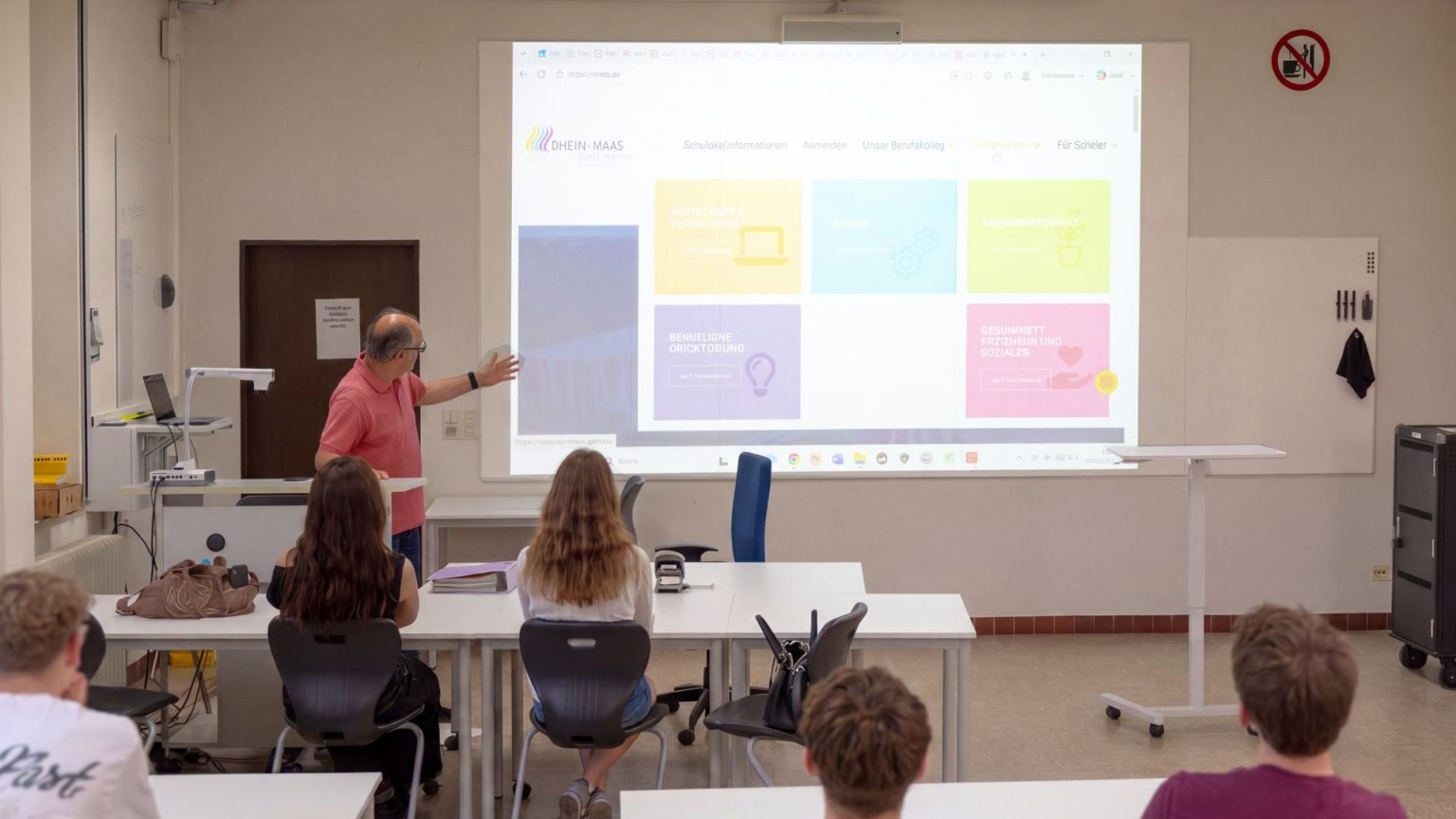
When a board is used mainly as a projection screen and the projected image needs to stay sharp, the Projection surface is the better choice. Its extremely matte finish eliminates glare almost entirely, so projectors deliver a clean, undistorted image regardless of the room’s lighting. It still writes with standard markers, though erasing needs a touch more effort than High Gloss or SatinTones, a whiteboard cleaning spray keeps it easy to maintain.
Chalk Graphite
A chalk surface gives you something the other finishes can’t: the ability to vary a line’s weight by pressing harder or softer, which matters for sketching, shading or freehand diagrams. Chalk Graphite is a matte, anthracite-coloured surface that reads as considered rather than purely functional, which is why it turns up in office and hospitality interiors as often as classrooms. It’s built on the same ceramic steel as every other Chameleon finish, so it stays perfectly wipeable rather than wearing down the way a traditional chalkboard does.

Chalk Canopy
Chalk Canopy is the more traditional green chalkboard finish, the colour most people associate with a classroom. Green provides strong contrast against white chalk, which keeps handwriting and diagrams easy to read, and it carries a calmer, more classic feel than Chalk Graphite. The main reason to choose a whiteboard over either chalk finish is chalk dust itself. If that’s a concern in the space, High Gloss or SatinTones deliver a similar writing experience without it.

Glassboards
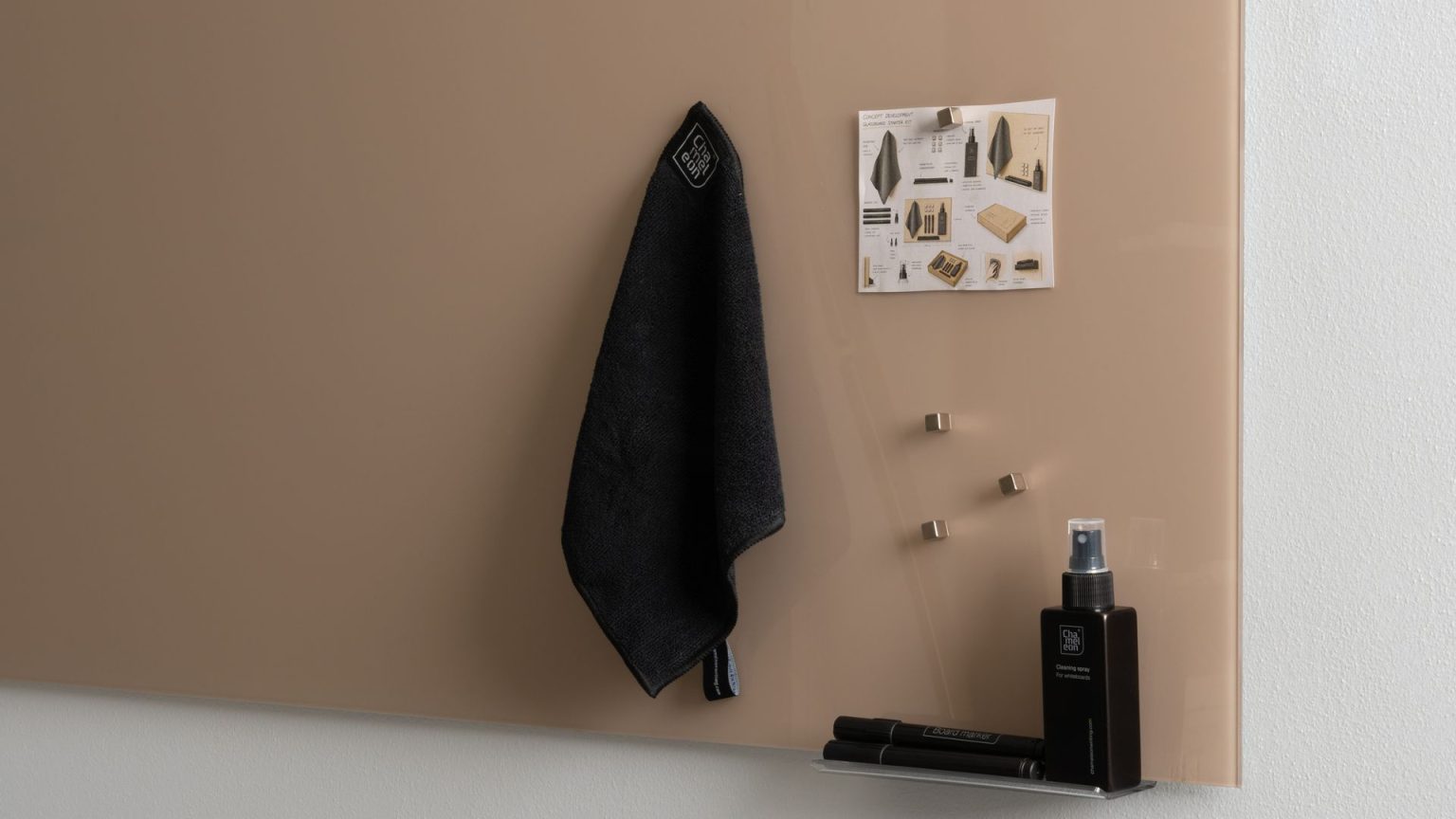
Glassboards are Chameleon’s alternative to ceramic steel: toughened safety glass in 18 colours, fired onto the back of the panel so the colour never wears off the writing side. They’re fully magnetic and dry-erase, though they need glassboard-specific magnets since standard magnets hold far more weakly on glass than on ceramic steel. Glass gives a more premium, boardroom-grade look and a bolder colour range than SatinTones, at a higher price point, and it is heavier and more fragile to handle during installation. For most everyday writing surfaces, ceramic steel is the more practical choice; glass earns its place where the interior specifically calls for it.
Which surface should you choose?
For an interior architect or client, this decision is rarely about which surface performs best on paper, it’s about which one fits the room’s lighting, the project’s material palette and how the space will actually be used day to day. A few starting points:
- If the board will be read from across the room, in a classroom, lecture hall or during presentations, High Gloss remains the safest specification. Its brightness keeps markings legible even at distance, and it’s the surface people already expect to see, which matters when a client wants zero risk on legibility.
- If the room has a lot of daylight, glass partitions, or the board needs to sit quietly within a considered interior rather than announce itself as office equipment, SatinTones is very often the better fit. With 15 colour tones it can be matched to timber, textiles or wall colour, which is why architects now specify it as the default rather than treating it as an upsell.
- If the board doubles as a projection screen and image quality during presentations genuinely matters, Projection is the only surface built specifically for that job. Specify it deliberately rather than assuming any whiteboard will do, since the trade-off, slightly harder erasing, is worth flagging to a client upfront rather than discovering it on site.
- If the brief calls for a more tactile, considered surface, in a design-led office, a hospitality space, or a classroom that wants to avoid a purely clinical look, Chalk Graphite or Chalk Canopy add texture and a different writing experience. The trade-off is occasional chalk dust, worth raising with a client who is sensitive to maintenance.
- If the project has the budget and the interior calls for a bolder, more premium material, boardrooms, reception areas, hospitality settings, Glassboards deliver a bolder colour range and a more finished, boardroom-grade look than any ceramic steel option, at a higher price and with more care needed during installation.
Every option shares the same lifetime warranty on writing and erasing, so nothing here is a technical downgrade, the decision is entirely about which surface serves the room, the budget and the way the space will actually be used. Explore the full whiteboard range or contact our team for a sample of any surface, or for project-specific advice before you specify.
Frequently asked questions
What is the difference between chalkboard and whiteboard?
Both are built on the same durable ceramic steel surface and carry the same lifetime warranty. The real difference is chalk: it lets you vary line weight by pressing harder or softer, which a whiteboard marker can’t do, but it produces dust and needs chalk rather than markers to maintain contrast.
What is a matte dry erase board?
A matte dry erase board has a low-reflection writing surface instead of a glossy one. Chameleon’s SatinTones range is a matte, fired-colour ceramic steel surface available in 15 tones, designed to stay readable under bright light without the glare of a glossy whiteboard.
What are the different types of whiteboard surfaces?
Chameleon offers four ceramic steel finishes, High Gloss, SatinTones (matte, in colour), Chalk (Graphite or Canopy) and Projection, plus Glassboards as a glass-based alternative. All are magnetic and dry-erase; the difference is reflectivity, colour and, for chalk, writing texture.
Is a low gloss whiteboard better than a high gloss one?
Neither is technically better, they perform identically for writing and erasing. Low-gloss surfaces like SatinTones reduce glare in bright or glass-walled rooms, while High Gloss stays the better choice when the board needs to be read clearly from a distance.
Can you use a whiteboard as a projection screen?
Yes, but a standard glossy surface will reflect glare from the projector. Chameleon’s dedicated Projection surface is matte enough to eliminate that reflection, giving a clearer projected image than High Gloss or SatinTones.
Need immediate help and advice with your choice?