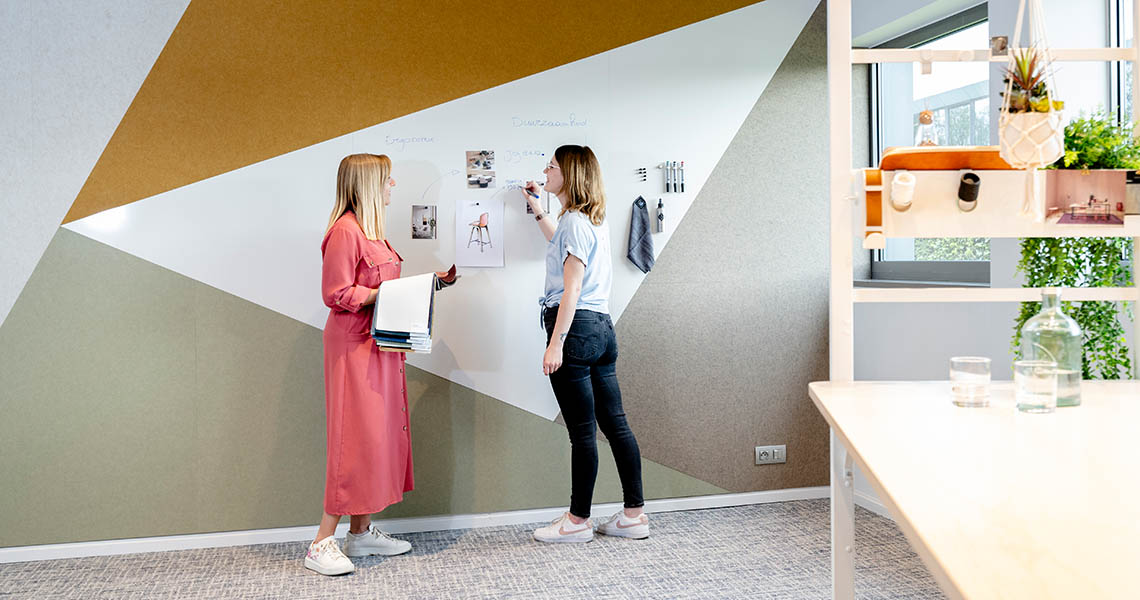
Leave shared spaces unbranded because branding feels like a reception-only decision, and a company misses one of the more consistently viewed surfaces in the building. More companies are branding shared spaces through custom whiteboards instead, because a board used daily gets more genuine attention than a static sign. Recognise that and a shared space starts working for brand visibility as well as it already works for collaboration.

Array
(
    [1049] => WP_Post Object
        (
            [ID] => 1049
            [post_author] => 1
            [post_date] => 2026-10-20 06:45:09
            [post_date_gmt] => 2019-08-05 13:54:24
            [post_content] =>
            [post_title] => Products
            [post_excerpt] =>
            [post_status] => publish
            [comment_status] => closed
            [ping_status] => closed
            [post_password] =>
            [post_name] => whiteboards-5
            [to_ping] =>
            [pinged] =>
            [post_modified] => 2026-10-20 06:45:09
            [post_modified_gmt] => 2026-10-20 06:45:09
            [post_content_filtered] =>
            [post_parent] => 0
            [guid] => https://chameleonwriting.falkor.alcor.cloud/?p=1049
            [menu_order] => 1
            [post_type] => nav_menu_item
            [post_mime_type] =>
            [comment_count] => 0
            [filter] => raw
            [db_id] => 1049
            [menu_item_parent] => 0
            [object_id] => 1049
            [object] => custom
            [type] => custom
            [type_label] => Custom Link
            [title] => Products
            [url] => #
            [target] =>
            [attr_title] =>
            [description] =>
            [classes] => Array
                (
                    [0] =>
                )

            [xfn] =>
        )

    [12842] => WP_Post Object
        (
            [ID] => 12842
            [post_author] => 82
            [post_date] => 2026-10-20 06:45:10
            [post_date_gmt] => 2023-08-31 08:07:16
            [post_content] =>
            [post_title] =>
            [post_excerpt] =>
            [post_status] => publish
            [comment_status] => closed
            [ping_status] => closed
            [post_password] =>
            [post_name] => 12842
            [to_ping] =>
            [pinged] =>
            [post_modified] => 2026-10-20 06:45:10
            [post_modified_gmt] => 2026-10-20 06:45:10
            [post_content_filtered] =>
            [post_parent] => 0
            [guid] => https://chameleonwriting.falkor.alcor.cloud/?p=12842
            [menu_order] => 68
            [post_type] => nav_menu_item
            [post_mime_type] =>
            [comment_count] => 0
            [filter] => raw
            [db_id] => 12842
            [menu_item_parent] => 0
            [object_id] => 12839
            [object] => page
            [type] => post_type
            [type_label] => Page
            [url] => https://chameleonwriting.com/en/references-3/
            [title] => References
            [target] =>
            [attr_title] =>
            [description] =>
            [classes] => Array
                (
                    [0] =>
                )

            [xfn] =>
        )

    [11862] => WP_Post Object
        (
            [ID] => 11862
            [post_author] => 82
            [post_date] => 2026-10-20 06:45:10
            [post_date_gmt] => 2023-08-21 13:36:51
            [post_content] =>
            [post_title] => pCon
            [post_excerpt] =>
            [post_status] => publish
            [comment_status] => closed
            [ping_status] => closed
            [post_password] =>
            [post_name] => pcon-data
            [to_ping] =>
            [pinged] =>
            [post_modified] => 2026-10-20 06:45:10
            [post_modified_gmt] => 2026-10-20 06:45:10
            [post_content_filtered] =>
            [post_parent] => 642
            [guid] => https://chameleonwriting.falkor.alcor.cloud/?p=11862
            [menu_order] => 69
            [post_type] => nav_menu_item
            [post_mime_type] =>
            [comment_count] => 0
            [filter] => raw
            [db_id] => 11862
            [menu_item_parent] => 0
            [object_id] => 4701
            [object] => page
            [type] => post_type
            [type_label] => Page
            [url] => https://chameleonwriting.com/en/information/chameleon-now-available-in-pcon/
            [title] => pCon
            [target] =>
            [attr_title] =>
            [description] =>
            [classes] => Array
                (
                    [0] =>
                )

            [xfn] =>
        )

    [32752] => WP_Post Object
        (
            [ID] => 32752
            [post_author] => 85
            [post_date] => 2026-10-20 06:45:10
            [post_date_gmt] => 2025-08-07 10:59:20
            [post_content] =>
            [post_title] => Order Samples
            [post_excerpt] =>
            [post_status] => publish
            [comment_status] => closed
            [ping_status] => closed
            [post_password] =>
            [post_name] => order-samples-2
            [to_ping] =>
            [pinged] =>
            [post_modified] => 2026-10-20 06:45:10
            [post_modified_gmt] => 2026-10-20 06:45:10
            [post_content_filtered] =>
            [post_parent] => 0
            [guid] => https://chameleonwriting.com/?p=32752
            [menu_order] => 70
            [post_type] => nav_menu_item
            [post_mime_type] =>
            [comment_count] => 0
            [filter] => raw
            [db_id] => 32752
            [menu_item_parent] => 0
            [object_id] => 32718
            [object] => page
            [type] => post_type
            [type_label] => Page
            [url] => https://chameleonwriting.com/en/chameleon-samples/
            [title] => Order Samples
            [target] =>
            [attr_title] =>
            [description] =>
            [classes] => Array
                (
                    [0] =>
                )

            [xfn] =>
        )

    [26482] => WP_Post Object
        (
            [ID] => 26482
            [post_author] => 85
            [post_date] => 2026-10-20 06:45:10
            [post_date_gmt] => 2025-01-17 11:08:57
            [post_content] =>
            [post_title] => Information
            [post_excerpt] =>
            [post_status] => publish
            [comment_status] => closed
            [ping_status] => closed
            [post_password] =>
            [post_name] => information-2
            [to_ping] =>
            [pinged] =>
            [post_modified] => 2026-10-20 06:45:10
            [post_modified_gmt] => 2026-10-20 06:45:10
            [post_content_filtered] =>
            [post_parent] => 0
            [guid] => https://chameleonwriting.com/?p=26482
            [menu_order] => 71
            [post_type] => nav_menu_item
            [post_mime_type] =>
            [comment_count] => 0
            [filter] => raw
            [db_id] => 26482
            [menu_item_parent] => 0
            [object_id] => 26482
            [object] => custom
            [type] => custom
            [type_label] => Custom Link
            [title] => Information
            [url] => #
            [target] =>
            [attr_title] =>
            [description] =>
            [classes] => Array
                (
                    [0] =>
                )

            [xfn] =>
        )

    [36031] => WP_Post Object
        (
            [ID] => 36031
            [post_author] => 85
            [post_date] => 2026-10-20 06:45:10
            [post_date_gmt] => 2025-11-12 11:54:33
            [post_content] =>
            [post_title] => ProTips
            [post_excerpt] =>
            [post_status] => publish
            [comment_status] => closed
            [ping_status] => closed
            [post_password] =>
            [post_name] => protips-2
            [to_ping] =>
            [pinged] =>
            [post_modified] => 2026-10-20 06:45:10
            [post_modified_gmt] => 2026-10-20 06:45:10
            [post_content_filtered] =>
            [post_parent] => 0
            [guid] => https://chameleonwriting.com/?p=36031
            [menu_order] => 78
            [post_type] => nav_menu_item
            [post_mime_type] =>
            [comment_count] => 0
            [filter] => raw
            [db_id] => 36031
            [menu_item_parent] => 0
            [object_id] => -325
            [object] => kennisbank
            [type] => post_type_archive
            [title] => ProTips
            [type_label] => Post Type Archive
            [url] => https://chameleonwriting.com/en/protips/
            [target] =>
            [attr_title] =>
            [description] =>
            [classes] => Array
                (
                    [0] =>
                )

            [xfn] =>
        )

    [19332] => WP_Post Object
        (
            [ID] => 19332
            [post_author] => 3
            [post_date] => 2026-10-20 06:45:10
            [post_date_gmt] => 2024-05-14 11:58:44
            [post_content] =>
            [post_title] => Contact
            [post_excerpt] =>
            [post_status] => publish
            [comment_status] => closed
            [ping_status] => closed
            [post_password] =>
            [post_name] => contact-4
            [to_ping] =>
            [pinged] =>
            [post_modified] => 2026-10-20 06:45:10
            [post_modified_gmt] => 2026-10-20 06:45:10
            [post_content_filtered] =>
            [post_parent] => 0
            [guid] => https://chameleonwriting.com/?p=19332
            [menu_order] => 79
            [post_type] => nav_menu_item
            [post_mime_type] =>
            [comment_count] => 0
            [filter] => raw
            [db_id] => 19332
            [menu_item_parent] => 0
            [object_id] => 19332
            [object] => custom
            [type] => custom
            [type_label] => Custom Link
            [title] => Contact
            [url] => https://chameleonwriting.com/en/contact/
            [target] =>
            [attr_title] =>
            [description] =>
            [classes] => Array
                (
                    [0] =>
                )

            [xfn] =>
        )

    [12326] => WP_Post Object
        (
            [ID] => 12326
            [post_author] => 82
            [post_date] => 2026-10-20 06:45:10
            [post_date_gmt] => 2023-08-25 07:08:58
            [post_content] =>
            [post_title] => Languages
            [post_excerpt] =>
            [post_status] => publish
            [comment_status] => closed
            [ping_status] => closed
            [post_password] =>
            [post_name] => taalschakelaar-6
            [to_ping] =>
            [pinged] =>
            [post_modified] => 2026-10-20 06:45:10
            [post_modified_gmt] => 2026-10-20 06:45:10
            [post_content_filtered] =>
            [post_parent] => 0
            [guid] => https://chameleonwriting.falkor.alcor.cloud/?p=12326
            [menu_order] => 80
            [post_type] => nav_menu_item
            [post_mime_type] =>
            [comment_count] => 0
            [filter] => raw
            [db_id] => 12326
            [menu_item_parent] => 0
            [object_id] => 12326
            [object] => custom
            [type] => custom
            [type_label] => Language switcher
            [title] => EN
            [url] => #pll_switcher
            [target] =>
            [attr_title] =>
            [description] =>
            [classes] => Array
                (
                    [0] => pll-parent-menu-item
                )

            [xfn] =>
        )

)
1
News
Why more companies are branding shared spaces through custom whiteboards
Why shared spaces were often overlooked
Branding budgets have traditionally focused on reception areas and client-facing rooms, since those are the spaces visitors see first. Shared internal spaces, used daily by staff rather than guests, were often left with generic, unbranded fittings, including whatever whiteboard happened to be available. This gap has become more noticeable as companies pay closer attention to the overall employee experience across every part of the office. As remote and hybrid work has made in-office time feel more intentional, companies have started paying closer attention to every space employees actually use, not just the ones visitors see. That change in perspective is a big part of why break rooms, hallways and informal collaboration corners are now getting the same level of design attention as a boardroom once did. That imbalance is easy to miss until someone actually points it out, at which point it tends to seem obvious.
Chameleon’s SatinTones range offers 15 tones for this purpose, and because the colour sits within the same ceramic steel surface rather than an applied coating, a branded board still carries the same lifetime warranty on writing and erasing as a standard one.
What a branded whiteboard actually adds
A custom whiteboard with a company’s colours or logo integrated into the frame or surface turns a purely functional object into a small, consistent piece of the brand experience, reinforcing identity in a space employees interact with far more often than any reception area. Even a subtle touch, such as a colour-matched frame, can be enough to signal that a shared space was considered rather than furnished as an afterthought. Employees often notice these small details more than expected, since they interact with shared spaces repeatedly throughout an ordinary working week. It also means new employees encounter a consistent identity from their very first day, rather than piecing together an impression from a mix of branded and unbranded spaces. Small, consistent details like this accumulate into a noticeably more considered impression of the workplace over time.
Why employee-facing spaces matter for brand consistency
Internal brand consistency affects how staff experience the company day to day, not just how visitors perceive it. A shared space that reflects the same identity as the rest of the office tends to feel more considered and less like an afterthought. A workplace that feels cohesive throughout, rather than polished only where visitors go, tends to reinforce a stronger sense of shared identity among staff.

How this fits into wider office branding trends
This shift reflects a broader move toward treating every part of an office, not just the most visible rooms, as part of the overall brand environment. Custom whiteboards are a relatively low-cost way to extend that consistency into spaces that would otherwise stay generic, since they are already a functional necessity in most shared spaces and simply need a finish decision, such as a colour-matched frame or a waterjet-cut logo, layered on top rather than a whole new fixture. It is a low-friction way to make measurable progress on this goal without a large redesign budget.
What to consider before branding a shared whiteboard
Balancing brand presence with everyday usability matters most in shared spaces, since these boards tend to see heavier and more varied use than a single-team meeting room board. Keeping branding to edges or a header strip, rather than the full writing area, tends to work best here too. Getting this balance right usually means testing the proposed finish against how the board is actually used before committing to a full rollout across multiple spaces.

Measuring whether branding a shared space actually lands
Unlike a client-facing reception area, a shared internal space rarely gets formal feedback about how its design is received, which makes it easy to assume a branding investment is working without any real evidence either way. Simple signals, such as whether staff comment on the space, whether it gets used more once refreshed, or whether new hires mention it during onboarding conversations, give a rough but useful sense of impact. Some companies also track how often a shared space is booked or used informally before and after a refresh, treating the whiteboard update as one part of a wider space improvement rather than an isolated purchase. This kind of light-touch measurement does not need to be scientific to be useful; it mainly helps justify extending the same approach to other shared spaces if the first attempt is well received, or adjusting the approach if it is not.
What a phased rollout across shared spaces can look like
Rather than branding every shared space at once, several companies have taken a phased approach, starting with the single most-used shared area, such as a main break room or central collaboration corner, before deciding whether to extend the same treatment elsewhere. This lets a company judge real reaction and durability before committing budget across an entire office, and it also spreads the cost over a longer period rather than requiring one large purchase. A phased rollout also allows small adjustments between phases, such as refining a colour choice or branding placement based on how the first space is actually received, so that later installations benefit from lessons learned on the first one rather than repeating the same decisions everywhere at once. It also gives budget holders an easier approval decision, since a single pilot space is a far smaller ask than a full-office commitment made on assumption alone.
Looking for a custom whiteboard?
Learn how Chameleon custom whiteboards can be specified for your project.
Need immediate help and advice with your choice?