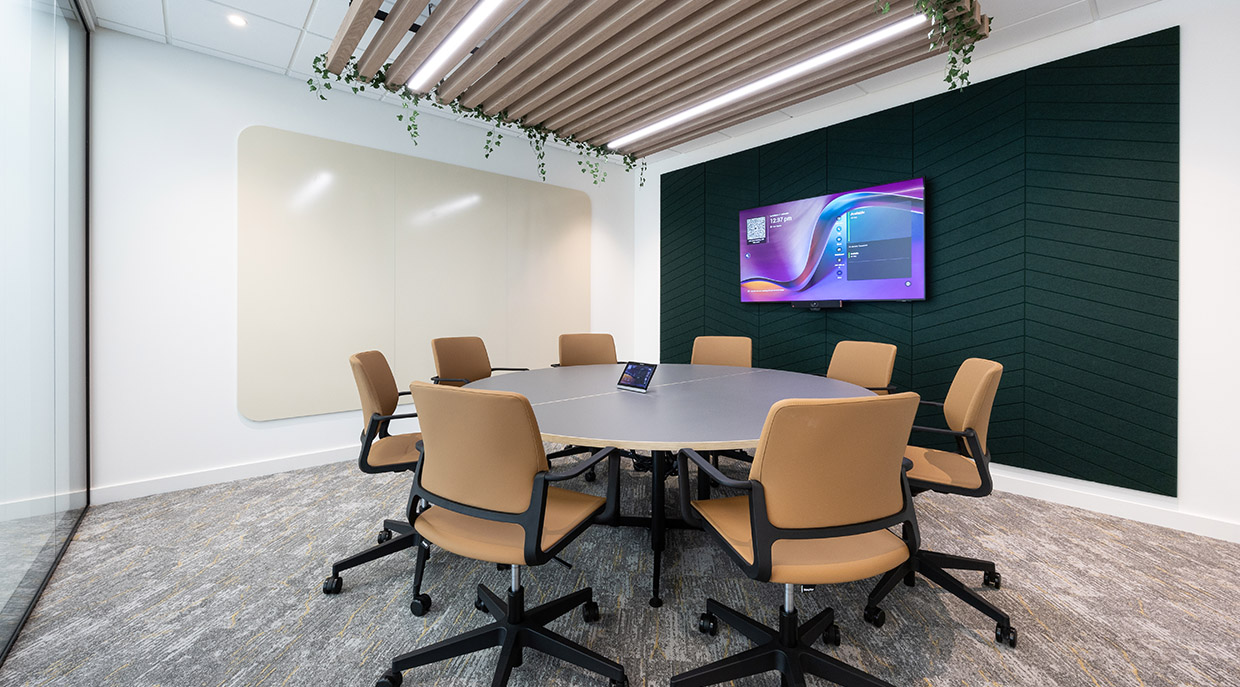
A whiteboard often seems like a small detail in a project, yet its impact on appearance, collaboration and daily use is considerable. Glassboards are often chosen for their sleek, modern look, but luxury doesn’t always have to shine. Chameleon whiteboards with SatinTones offer an aesthetically equal alternative with a subtly matte surface that combines style, writing comfort, durability and ease of use. For interior architects, shopfitters and end users in education or office environments, this is an option worth a closer look.

Array
(
    [1049] => WP_Post Object
        (
            [ID] => 1049
            [post_author] => 1
            [post_date] => 2026-10-20 06:45:09
            [post_date_gmt] => 2019-08-05 13:54:24
            [post_content] =>
            [post_title] => Products
            [post_excerpt] =>
            [post_status] => publish
            [comment_status] => closed
            [ping_status] => closed
            [post_password] =>
            [post_name] => whiteboards-5
            [to_ping] =>
            [pinged] =>
            [post_modified] => 2026-10-20 06:45:09
            [post_modified_gmt] => 2026-10-20 06:45:09
            [post_content_filtered] =>
            [post_parent] => 0
            [guid] => https://chameleonwriting.falkor.alcor.cloud/?p=1049
            [menu_order] => 1
            [post_type] => nav_menu_item
            [post_mime_type] =>
            [comment_count] => 0
            [filter] => raw
            [db_id] => 1049
            [menu_item_parent] => 0
            [object_id] => 1049
            [object] => custom
            [type] => custom
            [type_label] => Custom Link
            [title] => Products
            [url] => #
            [target] =>
            [attr_title] =>
            [description] =>
            [classes] => Array
                (
                    [0] =>
                )

            [xfn] =>
        )

    [12842] => WP_Post Object
        (
            [ID] => 12842
            [post_author] => 82
            [post_date] => 2026-10-20 06:45:10
            [post_date_gmt] => 2023-08-31 08:07:16
            [post_content] =>
            [post_title] =>
            [post_excerpt] =>
            [post_status] => publish
            [comment_status] => closed
            [ping_status] => closed
            [post_password] =>
            [post_name] => 12842
            [to_ping] =>
            [pinged] =>
            [post_modified] => 2026-10-20 06:45:10
            [post_modified_gmt] => 2026-10-20 06:45:10
            [post_content_filtered] =>
            [post_parent] => 0
            [guid] => https://chameleonwriting.falkor.alcor.cloud/?p=12842
            [menu_order] => 68
            [post_type] => nav_menu_item
            [post_mime_type] =>
            [comment_count] => 0
            [filter] => raw
            [db_id] => 12842
            [menu_item_parent] => 0
            [object_id] => 12839
            [object] => page
            [type] => post_type
            [type_label] => Page
            [url] => https://chameleonwriting.com/en/references-3/
            [title] => References
            [target] =>
            [attr_title] =>
            [description] =>
            [classes] => Array
                (
                    [0] =>
                )

            [xfn] =>
        )

    [11862] => WP_Post Object
        (
            [ID] => 11862
            [post_author] => 82
            [post_date] => 2026-10-20 06:45:10
            [post_date_gmt] => 2023-08-21 13:36:51
            [post_content] =>
            [post_title] => pCon
            [post_excerpt] =>
            [post_status] => publish
            [comment_status] => closed
            [ping_status] => closed
            [post_password] =>
            [post_name] => pcon-data
            [to_ping] =>
            [pinged] =>
            [post_modified] => 2026-10-20 06:45:10
            [post_modified_gmt] => 2026-10-20 06:45:10
            [post_content_filtered] =>
            [post_parent] => 642
            [guid] => https://chameleonwriting.falkor.alcor.cloud/?p=11862
            [menu_order] => 69
            [post_type] => nav_menu_item
            [post_mime_type] =>
            [comment_count] => 0
            [filter] => raw
            [db_id] => 11862
            [menu_item_parent] => 0
            [object_id] => 4701
            [object] => page
            [type] => post_type
            [type_label] => Page
            [url] => https://chameleonwriting.com/en/information/chameleon-now-available-in-pcon/
            [title] => pCon
            [target] =>
            [attr_title] =>
            [description] =>
            [classes] => Array
                (
                    [0] =>
                )

            [xfn] =>
        )

    [32752] => WP_Post Object
        (
            [ID] => 32752
            [post_author] => 85
            [post_date] => 2026-10-20 06:45:10
            [post_date_gmt] => 2025-08-07 10:59:20
            [post_content] =>
            [post_title] => Order Samples
            [post_excerpt] =>
            [post_status] => publish
            [comment_status] => closed
            [ping_status] => closed
            [post_password] =>
            [post_name] => order-samples-2
            [to_ping] =>
            [pinged] =>
            [post_modified] => 2026-10-20 06:45:10
            [post_modified_gmt] => 2026-10-20 06:45:10
            [post_content_filtered] =>
            [post_parent] => 0
            [guid] => https://chameleonwriting.com/?p=32752
            [menu_order] => 70
            [post_type] => nav_menu_item
            [post_mime_type] =>
            [comment_count] => 0
            [filter] => raw
            [db_id] => 32752
            [menu_item_parent] => 0
            [object_id] => 32718
            [object] => page
            [type] => post_type
            [type_label] => Page
            [url] => https://chameleonwriting.com/en/chameleon-samples/
            [title] => Order Samples
            [target] =>
            [attr_title] =>
            [description] =>
            [classes] => Array
                (
                    [0] =>
                )

            [xfn] =>
        )

    [26482] => WP_Post Object
        (
            [ID] => 26482
            [post_author] => 85
            [post_date] => 2026-10-20 06:45:10
            [post_date_gmt] => 2025-01-17 11:08:57
            [post_content] =>
            [post_title] => Information
            [post_excerpt] =>
            [post_status] => publish
            [comment_status] => closed
            [ping_status] => closed
            [post_password] =>
            [post_name] => information-2
            [to_ping] =>
            [pinged] =>
            [post_modified] => 2026-10-20 06:45:10
            [post_modified_gmt] => 2026-10-20 06:45:10
            [post_content_filtered] =>
            [post_parent] => 0
            [guid] => https://chameleonwriting.com/?p=26482
            [menu_order] => 71
            [post_type] => nav_menu_item
            [post_mime_type] =>
            [comment_count] => 0
            [filter] => raw
            [db_id] => 26482
            [menu_item_parent] => 0
            [object_id] => 26482
            [object] => custom
            [type] => custom
            [type_label] => Custom Link
            [title] => Information
            [url] => #
            [target] =>
            [attr_title] =>
            [description] =>
            [classes] => Array
                (
                    [0] =>
                )

            [xfn] =>
        )

    [36031] => WP_Post Object
        (
            [ID] => 36031
            [post_author] => 85
            [post_date] => 2026-10-20 06:45:10
            [post_date_gmt] => 2025-11-12 11:54:33
            [post_content] =>
            [post_title] => ProTips
            [post_excerpt] =>
            [post_status] => publish
            [comment_status] => closed
            [ping_status] => closed
            [post_password] =>
            [post_name] => protips-2
            [to_ping] =>
            [pinged] =>
            [post_modified] => 2026-10-20 06:45:10
            [post_modified_gmt] => 2026-10-20 06:45:10
            [post_content_filtered] =>
            [post_parent] => 0
            [guid] => https://chameleonwriting.com/?p=36031
            [menu_order] => 78
            [post_type] => nav_menu_item
            [post_mime_type] =>
            [comment_count] => 0
            [filter] => raw
            [db_id] => 36031
            [menu_item_parent] => 0
            [object_id] => -325
            [object] => kennisbank
            [type] => post_type_archive
            [title] => ProTips
            [type_label] => Post Type Archive
            [url] => https://chameleonwriting.com/en/protips/
            [target] =>
            [attr_title] =>
            [description] =>
            [classes] => Array
                (
                    [0] =>
                )

            [xfn] =>
        )

    [19332] => WP_Post Object
        (
            [ID] => 19332
            [post_author] => 3
            [post_date] => 2026-10-20 06:45:10
            [post_date_gmt] => 2024-05-14 11:58:44
            [post_content] =>
            [post_title] => Contact
            [post_excerpt] =>
            [post_status] => publish
            [comment_status] => closed
            [ping_status] => closed
            [post_password] =>
            [post_name] => contact-4
            [to_ping] =>
            [pinged] =>
            [post_modified] => 2026-10-20 06:45:10
            [post_modified_gmt] => 2026-10-20 06:45:10
            [post_content_filtered] =>
            [post_parent] => 0
            [guid] => https://chameleonwriting.com/?p=19332
            [menu_order] => 79
            [post_type] => nav_menu_item
            [post_mime_type] =>
            [comment_count] => 0
            [filter] => raw
            [db_id] => 19332
            [menu_item_parent] => 0
            [object_id] => 19332
            [object] => custom
            [type] => custom
            [type_label] => Custom Link
            [title] => Contact
            [url] => https://chameleonwriting.com/en/contact/
            [target] =>
            [attr_title] =>
            [description] =>
            [classes] => Array
                (
                    [0] =>
                )

            [xfn] =>
        )

    [12326] => WP_Post Object
        (
            [ID] => 12326
            [post_author] => 82
            [post_date] => 2026-10-20 06:45:10
            [post_date_gmt] => 2023-08-25 07:08:58
            [post_content] =>
            [post_title] => Languages
            [post_excerpt] =>
            [post_status] => publish
            [comment_status] => closed
            [ping_status] => closed
            [post_password] =>
            [post_name] => taalschakelaar-6
            [to_ping] =>
            [pinged] =>
            [post_modified] => 2026-10-20 06:45:10
            [post_modified_gmt] => 2026-10-20 06:45:10
            [post_content_filtered] =>
            [post_parent] => 0
            [guid] => https://chameleonwriting.falkor.alcor.cloud/?p=12326
            [menu_order] => 80
            [post_type] => nav_menu_item
            [post_mime_type] =>
            [comment_count] => 0
            [filter] => raw
            [db_id] => 12326
            [menu_item_parent] => 0
            [object_id] => 12326
            [object] => custom
            [type] => custom
            [type_label] => Language switcher
            [title] => EN
            [url] => #pll_switcher
            [target] =>
            [attr_title] =>
            [description] =>
            [classes] => Array
                (
                    [0] => pll-parent-menu-item
                )

            [xfn] =>
        )

)
1
News
SatinTones vs glassboards: 6 key differences at a glance
What exactly are SatinTones and glassboards?
Glassboards are made from toughened safety glass and are available in various colours. Their glossy surface gives them a luxurious, contemporary look, which is why they are often preferred in meeting rooms, executive floors and other representative settings.
SatinTones refers to whiteboards made from ceramic steel with a matte surface in modern, stylish colours. The colour is fired into the ceramic steel rather than applied on top, which makes the enamelled top layer scratch-resistant, colourfast and extremely durable. The low-reflection surface creates visual calm, making it well suited to considered interiors that value writing comfort, material harmony and careful design.
Both are high-quality options, but they differ significantly in user experience, aesthetics and practical application.
The six differences
Choosing a whiteboard for a school, office or commercial project today goes far beyond pure functionality. Appearance, comfort, integration, ease of installation and sustainability matter just as much. Below we compare glassboards with Chameleon whiteboards in SatinTones across six areas, and show what that means for users, installers and end clients.

1. Readability and user experience
A whiteboard’s first job is to do its job: stay clearly readable from every angle, without distracting reflections.
Glassboards reflect light, especially in rooms with daylight or strong artificial lighting, which can make content hard to read from certain positions or distances. SatinTones have a matte surface that scatters light instead of reflecting it, reducing glare and improving readability. In classrooms and meeting rooms where the board is viewed from every corner, this calm surface makes a real difference.
2. Writing comfort and maintenance
The surface determines not only how a board looks, but also how it feels to write on and how easy it is to clean.
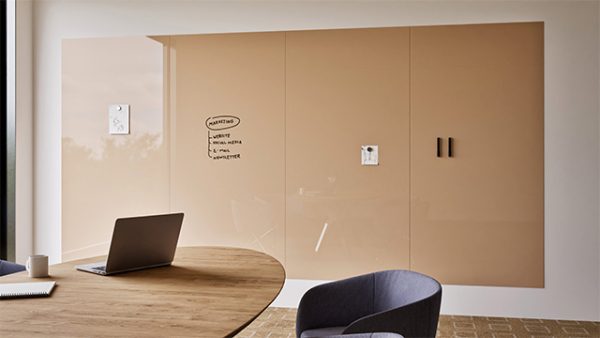
Glass has a very smooth surface, which can feel slippery and unnatural to write on, though it wipes clean easily. SatinTones offer a comfortable writing friction, strong ink adhesion and effortless cleaning thanks to the ceramic steel top layer. Even after years of intensive use, the surface keeps performing like new, without the ghosting that builds up on lower-quality materials.

3. Aesthetics and integration
Luxury doesn’t always mean shine. Often it’s the understated material choice that elevates a design.
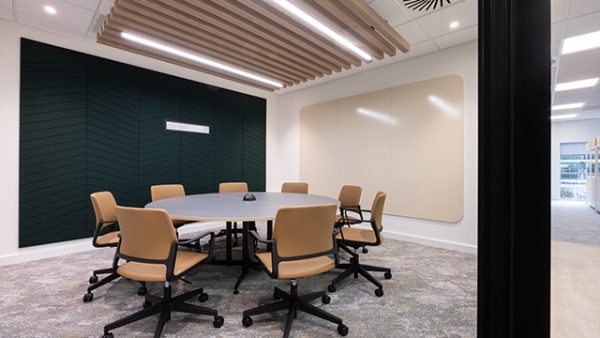
Glassboards are striking, with a gloss and depth that work well in spaces meant to make a statement, but that same quality can distract in calm, minimalist interiors. SatinTones are designed to blend into the wider interior. They follow the architectural lines without drawing attention to themselves, and the soft colour tones sit well alongside wood, textile, felt and other natural materials.
4. Customisation and design freedom
No two projects are the same, which is why flexibility is essential.
Glassboards are mostly available in standard sizes with limited scope for shape or edge detail, and custom shapes or integration into bespoke furniture are technically complex and costly. SatinTones allow for extensive customisation, from specific dimensions and cut-outs for sockets or cables to rounded shapes and complete wall installations. That makes seamless integration into the space and its use straightforward to achieve.

5. Sustainability
In tenders and modern project design, sustainability is no longer a trend, it’s a requirement.
Glass is technically recyclable, but difficult in practice: the colour is usually applied to the back and permanently bonded, making clean separation and reuse nearly impossible. SatinTones are designed with sustainability in mind. They are demountable, reusable and recyclable, and the ceramic steel surface keeps its quality over decades of use.
6. Easy installation and flexibility
On commercial fit-out projects, every hour of installation time and every millimetre of precision counts.
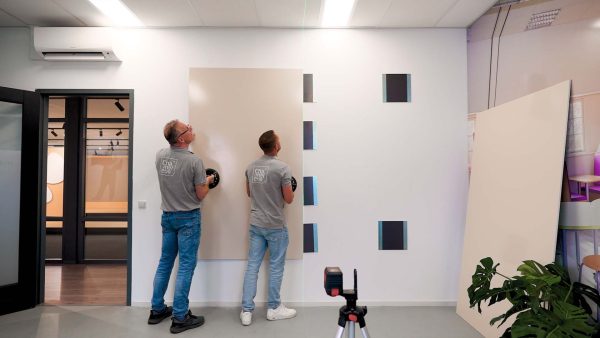
Glassboards are heavy and fragile, and the risk of transport damage or breakage increases with larger formats. SatinTones are lighter and use a magnetic mounting system, making them easy to install, reposition or replace. That suits changing floor plans, renovation projects and modular interiors.
Who are SatinTones ideal for?
For interior architects, SatinTones offer design freedom: no distracting glare, but a calm, understated element that sits well with the overall concept, in colours that suit contemporary interiors without compromising on quality or presence. For dealers and professionals, it’s a product that installs quickly and safely, meets sustainability criteria and performs reliably for years, economically sound and operationally dependable. And for end users in education and office settings, it brings clarity and calm to the classroom, and comfort, ergonomics and visual quality to the workplace, without ghosting and without glare.
Checklist: when to choose SatinTones whiteboards
You want a premium look without reflections. You need functional writing comfort for daily use. You value aesthetics and seamless interior integration. You’re working on projects with strict sustainability targets. You’re looking for a durable solution that’s easy to install. And you need tailored solutions that genuinely fit your design.
If several of these apply, SatinTones is likely the better choice. Explore the full range of Chameleon whiteboards to discover the surfaces, shapes and colours available for your project.
Experience the difference for yourself
Are you an interior architect, dealer, facility manager or decision-maker in education or business? Now is the perfect moment to discover SatinTones in person.
Request a free colour sample, book a demo, or visit our showroom. Our specialists are happy to advise on tailored solutions, applications and integration into your project.
Frequently asked questions
What is the difference between SatinTones and glassboards?
Glassboards are made from toughened glass with a glossy surface, while SatinTones are ceramic steel whiteboards with a matte surface. The main differences lie in readability, writing comfort, integration and sustainability.
Are SatinTones more readable than glassboards?
Yes. The matte ceramic steel surface scatters light instead of reflecting it, reducing glare and keeping content readable from every angle, unlike the glossy surface of a glassboard.
Are SatinTones more sustainable than glassboards?
SatinTones are demountable, reusable and recyclable, and the ceramic steel surface lasts for decades. Glass is technically recyclable but difficult to separate and reuse, since the colour is permanently bonded.
Can SatinTones be customised?
Yes. SatinTones can be made in specific dimensions, with cut-outs for sockets or cables, in rounded shapes, or as complete wall installations, which is generally not possible with glassboards.
Are SatinTones suitable for classrooms?
Yes. The low-glare surface, writing comfort and durability make them well suited to classrooms, where clarity, calm and resistance to intensive daily use matter.
Need immediate help and advice with your choice?